
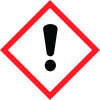
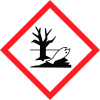
Información General
Fecha de revisión:
2021-07-27
A. Nombre del producto
1-OCTANOTIOL PARA SINTESIS
número CAS
111-88-6
1.5 Uso recomendado:
usos
IÍconos en FDS
Información de la empresa
Empresa
MERCK S.A
Información GHS
Palabra clave
Advertencia
Hazard Codes
Declaraciones de peligro (CLP)
H317, H335, H400, H410
Declaraciones de peligro
Código
Declaraciones
H317
May cause an allergic skin reaction
Sección 2
SECCIÓN 2: Identificación de los peligros
No 1272/2008 Classification of the substance or mixture Classification according to Regulation (EC) No 1272/2008 Skin sensitization (Category 1), H317 Specific target organ toxicity - single exposure (Category 3), Respiratory system, H335 Short-term (acute) aquatic hazard (Category 1), H400 Long-term (chronic) aquatic hazard (Category 1), H410 For the full text of the H-Statements mentioned in this Section, see Section 16. 2.2 Label elements Labelling according Regulation (EC) No 1272/2008
Pictogramas de peligro
Signal word Warning Hazard statement(s) H317 May cause an allergic skin reaction. H335 May cause respiratory irritation. H410 Very toxic to aquatic life with long lasting effects. Precautionary statement(s) P261 Avoid breathing dust/ fume/ gas/ mist/ vapors/ spray. P271 Use only outdoors or in a well-ventilated area. P272 Contaminated work clothing should not be allowed out of the workplace. P273 Avoid release to the environment. P280 Wear protective gloves. P302 + P352 IF ON SKIN: Wash with plenty of water. Supplemental Hazard none Statements Etiquetado reducido (<= 125 ml)
Palabra de advertencia
Atención
Indicaciones de peligro
H317 Puede provocar una reacción alérgica en la piel. Declaración(es) de prudencia P261 Evitar respirar el polvo/ el humo/ el gas/ la niebla/ los vapores/ el aerosol. P272 Las prendas de trabajo contaminadas no podrán sacarse del lugar de trabajo. P280 Llevar guantes de protección. P302 + P352 EN CASO DE CONTACTO CON LA PIEL: Lavar con abundante agua. Suplementaria ninguno(a) del Peligro
2.3. Otros riesgos
Esta sustancia/mezcla no contiene componentes que se consideren que sean bioacumulativos y tóxicos persistentes (PBT) o muy bioacumulativos y muy persistentes (vPvB) a niveles del 0,1% o superiores.